Interior visit
We conclude our tour at the Chapel of Carmen, or the Chapel of the Council of the Town and Neighbours of Puebla de Sanabria.
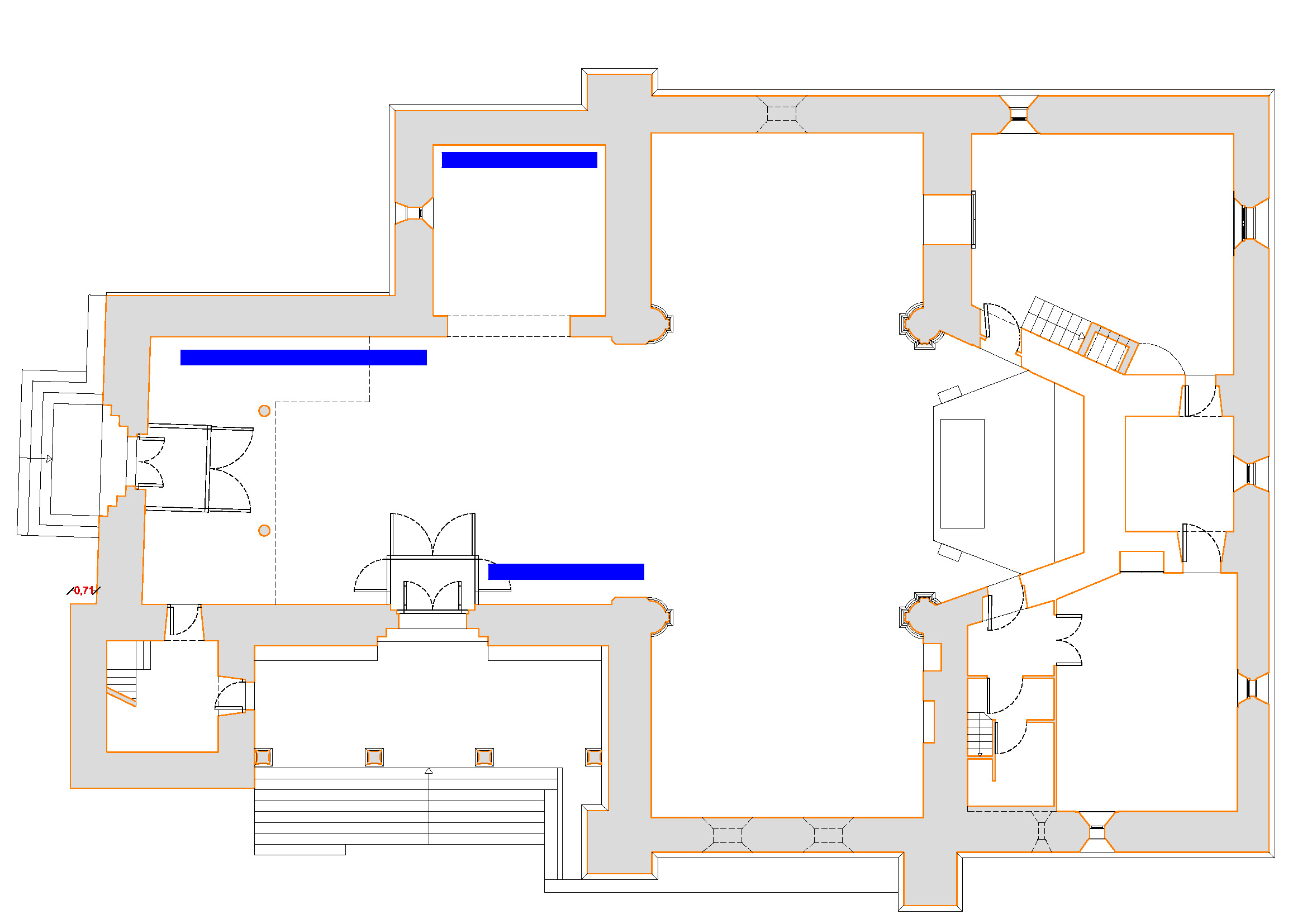
2.9 Chapel of Carmen
Originally, the owner of this chapel was the “Ecce Homo”.
This is recorded in a document written and signed by the secretary of the visitor during the sede vacante of the Diocese of Astorga in 1767.
We do not know the whereabouts of the Ecce Homo, which is only mentioned as not being in the provided location.
In the town of Puebla de Sanabria on the twelfth day of the month of March in the year one thousand seven hundred and sixty-seven, the council and its inhabitants being gathered in the usual place, having been summoned by the ringing of a special bell, and especially Juan Martínez, Mayor, etc…
and having been proposed by Mr Diego Fernández Morán, Priest and resident of this town, that Mr Francisco Colmenero, Apostolic Missionary for the greater Divine worship, increase the Devotion to Our Lady of Mount Carmel, wished to place her Image in the Chapel called the Council Chapel.[1]
[1] Ibid. Nota 50 Folios151vto. al 153vto.
Chapel of Our Lady of Mount Carmel.
Our Lady of Mount Carmel, also known as Our Lady of Carmen, is one of the most well-known and venerated Marian titles in the history of the Catholic Church, with her feast day celebrated on 16 July.
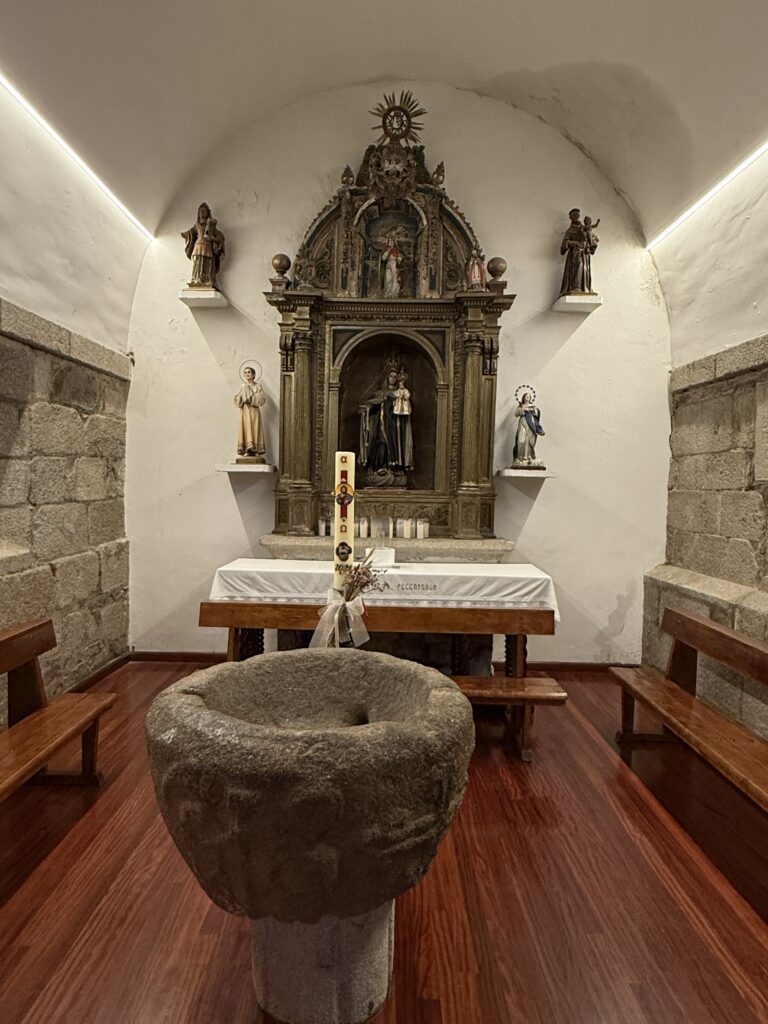
In this chapel, we find a niche altarpiece with an attic and crowning. The main body rests on a predella decorated with brushstroke foliage. It features prominent ledges supporting the fluted shaft columns of the main body, which in turn uphold the composite order capitals. These are flanked by pilasters with capitals adorned with volutes in a frontal position. Inside the semicircular arch stands the Virgin of Carmen with the Child.[1]
[1] Flor González Santos, Estudio sobre el estado de conservación de los bienes muebles de la iglesia de Santa María del Azogue en Puebla de Sanabria (Zamora), pag. 46
Its history begins in Israel, specifically on Mount Carmel, which is about 600 metres high and is near Haifa. Its name originates from Karm-El, meaning Garden or Vineyard of God.
The prophet Elijah lived in a cave on Mount Carmel. It was there that he demonstrated the power of the Lord before the priests of Baal, whose burnt offering God rejected.
Inspired by the prophet Elijah, a group of hermits went to live on Mount Carmel. Around the year 1200, the Order of Our Lady of Mount Carmel or Our Lady of Carmel was founded in the same place. On 16 July 1251, Our Lady of Mount Carmel appeared to the sixth Superior General of the Order, Saint Simon Stock, to whom she gave the scapular, one of the most distinctive symbols of this religious order.
The Virgin of Carmen is also called Star of the Sea and is the patron saint of sailors, partly due to the proximity of Mount Carmel to the Mediterranean. She is a symbol for vessels, signalling a safe harbour.[1]
[1] Roberto Alcántara Flores, Virgen del Carmen: fiesta, significado, escapulario, promesas, imágenes y oraciones, https://desdelafe.mx (Archidiócesis de Mexico 2023) Artículo.
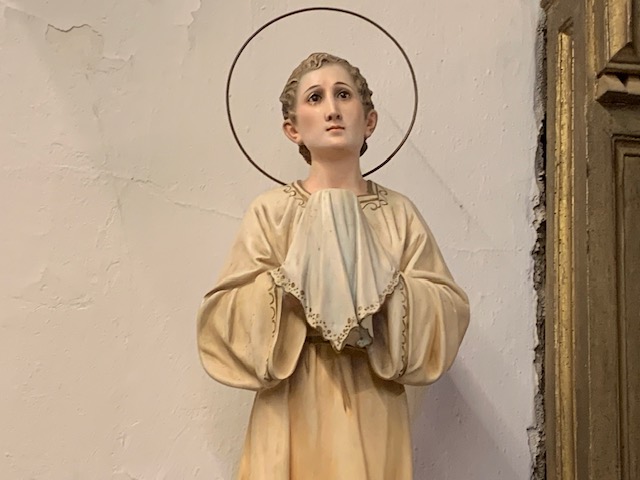
Bottom left, Saint Tarcisius, patron saint of acolytes and ministers of the Eucharist. Saint Tarcisius was martyred, stoned to death on the Appian Way (Rome) for defending the Sacrament of the Eucharist from a mob intent on desecrating it.
Sculptures
In the top left corner, we find Saint Barbara. Her feast day is celebrated on 4 December, and she is the patron saint of miners and artillerymen.
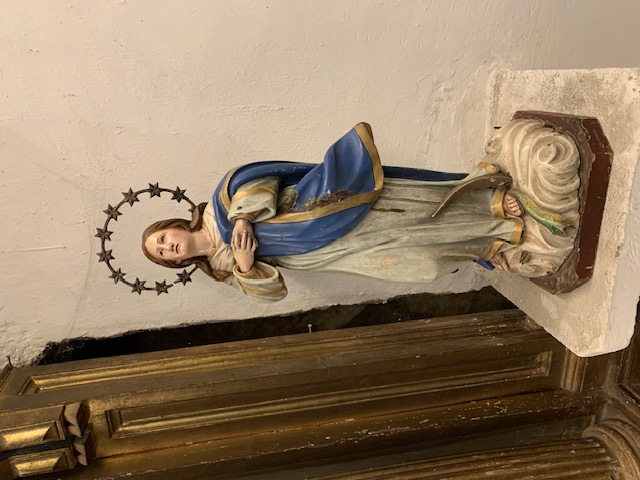
At the bottom right, the Immaculate Conception. Previously, there was a small altar retable dedicated to the Immaculate Conception, built in 1885, but no further information is available. It is likely that the image of the Immaculate Conception preserved in this chapel dates from that period.
The attic consists of a semicircular arch niche with the figure of Saint Blaise inside.
Saint Blasise
Few are the reports we receive from the Martyred Acts about the bishop and martyr of Sebaste, Saint Blaise; he secretly encouraged and strengthened Christians with his words and the example of his holy life. When he was brought before the prefect to declare his renunciation of Christianity, a mother presented her son, dying from a thorn stuck in his throat.
Saint Blaise lays his hand upon the dying, marks their throat with the sign of the cross, prays for them, and returns the child safe and sound to their distraught mother. He is especially invoked as a protector against throat illnesses. He was beheaded in the year 316, and his feast day is celebrated on 3 February[1].
[1] Blas Fagoaga, Año Cristiano -II-febrero, San Blas. Biblioteca de Autores Cristianos (Madrid 2004) Pág. 63-67
Top right.
Saint Anthony of Padua, according to the oldest biographer, was born in Lisbon (between the years 1188 and 1191), in a house owned by his parents near the cathedral, where he was baptised in the baptistery eight days after his birth and was given the name Fernando.
From a very young age, he showed a special devotion to the Virgin. He was intellectually educated according to the curriculum of the cathedral schools of that time. In his youth, he was overcome by the violence of passions, but the chaste young man never, not even for a moment, yielded to the demands of puberty and pleasure.
This experience led him to enter the monastery of San Vicente de Fora, later moving to Coimbra. There he joined the Franciscan Order and changed his name from Fernando to Antonio. Some time later, he arrived in Morocco. Due to illness, it was decided to repatriate him, but because of circumstances at sea, he disembarked on the coasts of Sicily. His first field of apostolic action was Romagna; he was later appointed professor of theology and subsequently sent to France to combat the Albigensian heresy. Finally, he settled in Padua where he died on Friday, 13 June 1231.[1]
[1] Luis Arnaldich, OFM, Año Cristiano -VI- junio, San Antonio de Padua. Biblioteca de Autores Cristianos (Madrid 2004) Pag. 333-341
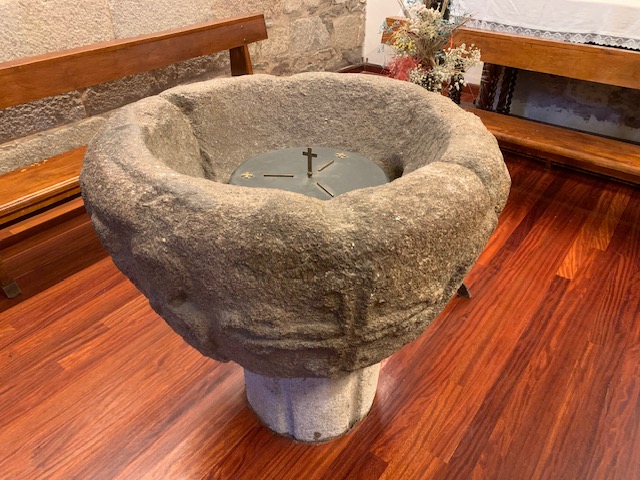
Baptismal Font.
Decorated with winged angels between two crosses that, by their style, appear to be from Calatrava. The base is a later addition.[1] Until its relocation in the 1990s to the interior of the church, it was situated in the outer atrium. The locals remember playing around it many times. Baptism is the gateway to the church, a community of believers. The newly baptised would then enter the temple to participate with the community in the liturgical assembly.
[1] Ibid. Nota 53. Pág. 56
The baptismal font made of granite stone, with a truncated conical shape, dates from the 13th century.
2.10 Painting of St. Francis Xavier
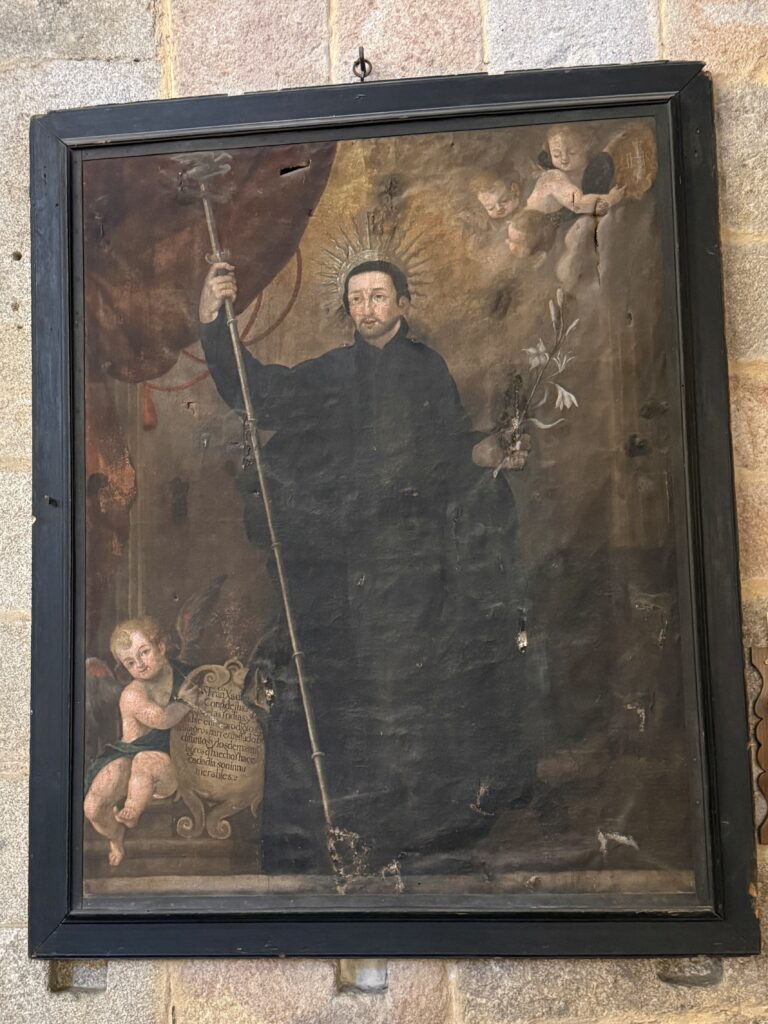
This is a painting depicting the Jesuit saint Saint Francis Xavier, whose feast day is celebrated on 3rd December. He was the first missionary to arrive in Japan, on 15th August 1549. He was a true adventurer and tireless missionary, a distinguished disciple of Saint Ignatius of Loyola.
The figure of the saint is depicted full-length, surrounded by a metallic crown of rays, wearing a Jesuit habit and cloak with a high collar. In his left hand, he holds a branch of lilies (a symbol of purity), and in his right, a cross topped with the dove of the Holy Spirit. As a missionary in Japan, this may be connected to the Nasrani Menorah, which is a cross topped with the dove of the Holy Spirit and is the most common symbol of Syrian Christians.
On the left side, a curtain is gathered. In the upper right corner, there are two cherub heads and an angel holding a plaque with the monogram of the name Jesus.
In the lower left corner, a naked winged angel is depicted sitting on a pedestal and holding a cartouche[1] with the following inscription: Saint Francis Xavier to the Company of Jesus, to those of the Indies, and admirable in wonders and miracles, he has resurrected 60 deceased and performed many other miracles. And every day the number grows innumerable.
[1] Ibid. Nota 53. Pág. 50
2.11 The Organ
We end our tour of the temple by raising our gaze to the choir loft, where the Baroque Organ rests. We find the details in the factory book: Mr Francisco Majo, an organ builder who came from the city of León to build the organ for this parish church. His stay in the town lasted four months.
Unfortunately, its melodies fell silent in the 1930s. Nearly a century has passed, and we have yet to bring it back to life.
Juan Blanco, a resident of the Villa, is responsible for gilding and painting the Organ case. Paulino Isla gilds the mouths of the organ pipes. Signed on 14 January 1788 by the parish priest at the time, Mr Diego Fernández Morán[1].
[1] 1 Puebla Libro de Fábrica, principia 1732 – 1790 termina. De la iglesia parroquial, Folios 210vto. al 212vto. (Archivo Diocesano de Astorga)
On the organ’s secret compartment, an inscription can be read: “Made by Manuel de San Juan in Logroño to the honour and glory of God, year 1788.” It is assumed that the organ builder reused parts from the previous instrument and placed the secret compartment made by this author. In 1742, forty-six years earlier, another organ had been made. According to records by Fr. Francisco Tallos, a master organ builder and Dominican friar residing in the city and monastery of Dominicans in the city of Toro, the parish priest at that time, D. Agustín Belicia Valboa, also confirms that there was an old organ whose metal was transported to Toro and then from Toro to here, from the new organ and its case[1].
[1] 1 Puebla Libro de Fábrica, principia 1732 – 1790 termina. De la iglesia parroquial, Folios 57vto. al 58vto (Archivo Diocesano de Astorga)
Thank you for your generous donation. Your support helps us preserve and restore the valuable heritage entrusted to us. We truly appreciate your contribution!
Conclusion
The purpose of this guide, dear reader, is none other than to reflect the profound spirituality conveyed by the parish church of Our Lady of the Azogue.
At present, we tend to view temples, churches, and cathedrals as museums housing valuable works of art, but the purpose of the artwork within our temples is to convey a lesson, a Biblical text from both the Old and New Testaments, and to inspire the desire to imitate the exemplary lives of the saints. They transport the believer to the supernatural and spiritual dimension emanating from the beauty, gestures, postures, and garments of the various paintings, images, sculptures, altarpieces, and more. These are representations of a far greater spiritual reality, impossible to fully describe or depict. Ultimately, the artists transmit the very beauty of the Creator through their work. Behind each piece lies Sacred Scripture, Church history, the magisterium, tradition, Christian theology, and faith; so when we enter the temple, we are transported to the divine realm—the place where we find the peace and calm that the daily hustle often robs us of. Undoubtedly, it is the place where it is easiest to encounter God, His Word, and to experience the power of His Spirit of Love.
Secondly, to provide the visitor with a documented and serious explanation of the architecture, sculpture, and painting that can be admired in this parish church. I must point out here that the oldest historical documentation I have been able to consult dates back to the year 1732. After an exhaustive search in the National Historical Archive in Madrid and the Historical Archive of the Nobility in Toledo, it has not been possible to find any documentation prior to that date. I believe it may be in the hands of private individuals or heirs of the last parish priest of the village, belonging to a family of minor nobility, Mr Lucas Aguilar Ossorio. Those documents contain the authorship, date, and cost of each of the altarpieces, mostly made at the same historical moment. There is the possibility that they have disappeared. We entrust their search to Saint Nicholas of Bari, and to the “Ecce Homo,” of which we preserve oil paintings in the Sacristy.
Finally, we would like to thank all the members of the parish who have contributed their small part to this simple guide, those who care for and maintain the parish church and all its furnishings in perfect condition. Thanks to everyone who helps preserve the heritage. We also extend our gratitude to the Town Hall of Puebla de Sanabria and the Tourist Office for their enthusiasm and effort in promoting culture and quality tourism.
Special thanks to Mr Pedro Barrio Losada, friend and loyal collaborator, who has reviewed, designed, and written the foreword for this guidebook of the parish church of Puebla de Sanabria. To María and Sofía, sisters who have laid out and organised the content and its photographs.
To my mother and my other mother, the Most Holy Mary, who supports my priestly ministry.
Agustín Rubio Huerga.
Consulted Bibliography
SAGRADA BIBLIA, versión oficial de la Conferencia Episcopal Española. Ed. Biblioteca de Autores Cristianos (Madrid 2014)
HORTENSIA LARRÉN IZQUIERDO Y LUIS PICHEL RAMOS, Bienes culturales de la provincia de Zamora, Imprenta Jambrina (Zamora 2010)
XABIER ETXEBERRIA, La espiritualidad en el románico; Instituto Diocesano de Teología y Pastoral. Desclée De Brouwer, D.L. (Bilbao 2010)
JUAN FERNANDO ROIG, Año Cristiano -I- enero, Biblioteca de Autores Cristinos (Madrid 2002)
BLAS FAGOAGA, Año Cristiano -II-febrero. Biblioteca de Autores Cristianos (Madrid 2004)
LUIS MORALES OLIVER, Año Cristiano – III – marzo, Biblioteca de Autores Cristianos (Madrid 2003)
LUIS ARNALDICH, OFM, Año Cristiano VI – junio, Biblioteca de Autores Cristianos (Madrid 2004)
ENRIQUE DENZINGER, El magisterio de la Iglesia, Empresa Editorial Herder, S.A. (Barcelona 1997)
1 Puebla Libro de Fábrica, principia 1732 – 1790 termina. De la iglesia parroquial; (Archivo Diocesano de Astorga)
Fábrica de la Puebla, principia en 1851. (Archivo Diocesano de Astorga)
FLOR GONZÁLEZ SANTOS, Estudio sobre el estado de conservación de los bienes muebles de la iglesia de Santa María del Azogue en Puebla de Sanabria (Zamora)
ALEJANDRA HERNÁNDEZ CLEMENTE, Ricardo Bellver y Ramón, su obra escultórica: un estudio historiográfico y documental. Tesis Doctoral (Madrid 2012)
JULIÁN GALENDE FURONES, Apuntes para una historia, Fiesta de las Victorias 1848-1998. 150 Aniversario. (Puebla de Sanabria 1998) (Archivo Parroquial)
Novena al Santísimo e Inmaculado Corazón DE MARÍA instalada en la Puebla de Sanabria, bajo la advocación de Nuestra Sra. de las Victorias. Est. Tipográfico de San José, San Andrés, 40, Bajo (Zamora 1905) (Archivo Parroquial)
ARTÍCULOS Y PÁGINAS WEB
PEDRO BARRADO, ¿Por qué a San José se le representa con una vara florecida? Vida Nueva Digital (Blog: La barba de Aarón 12/5/2021)
Diccionario de la Lengua Española, Ed. Vigesimotercera. Real Academia Española 2024.
FAUSTINO MARTÍNEZ GOÑI, Los siete dolores de la Virgen, https://catequesisenfamilia.es
Selecciones de Franciscanismo vol. XIII, Nº 37 (1984)
PÁGINA WEB DE LA ORDEN DE LOS CLÉRIGOS REGULARES TEATINOS, https://teatinos.org ROBERTO ALCÁNTARA FLORES, Virgen del Carmen: fiesta, significado, escapulario, promesas, imágenes y oraciones, (Archidiócesis de Méjico 2023) https://desdelafe.mx