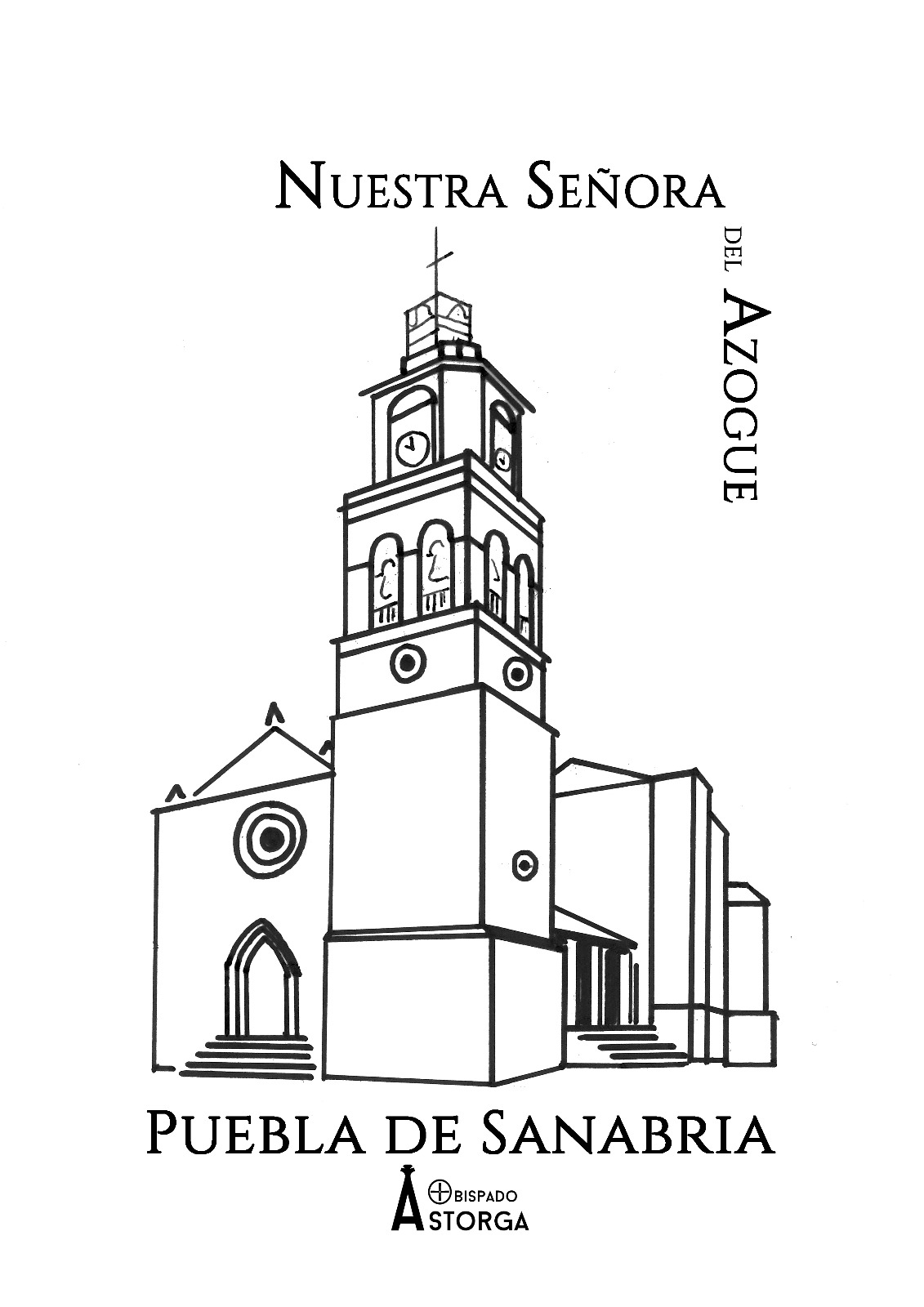
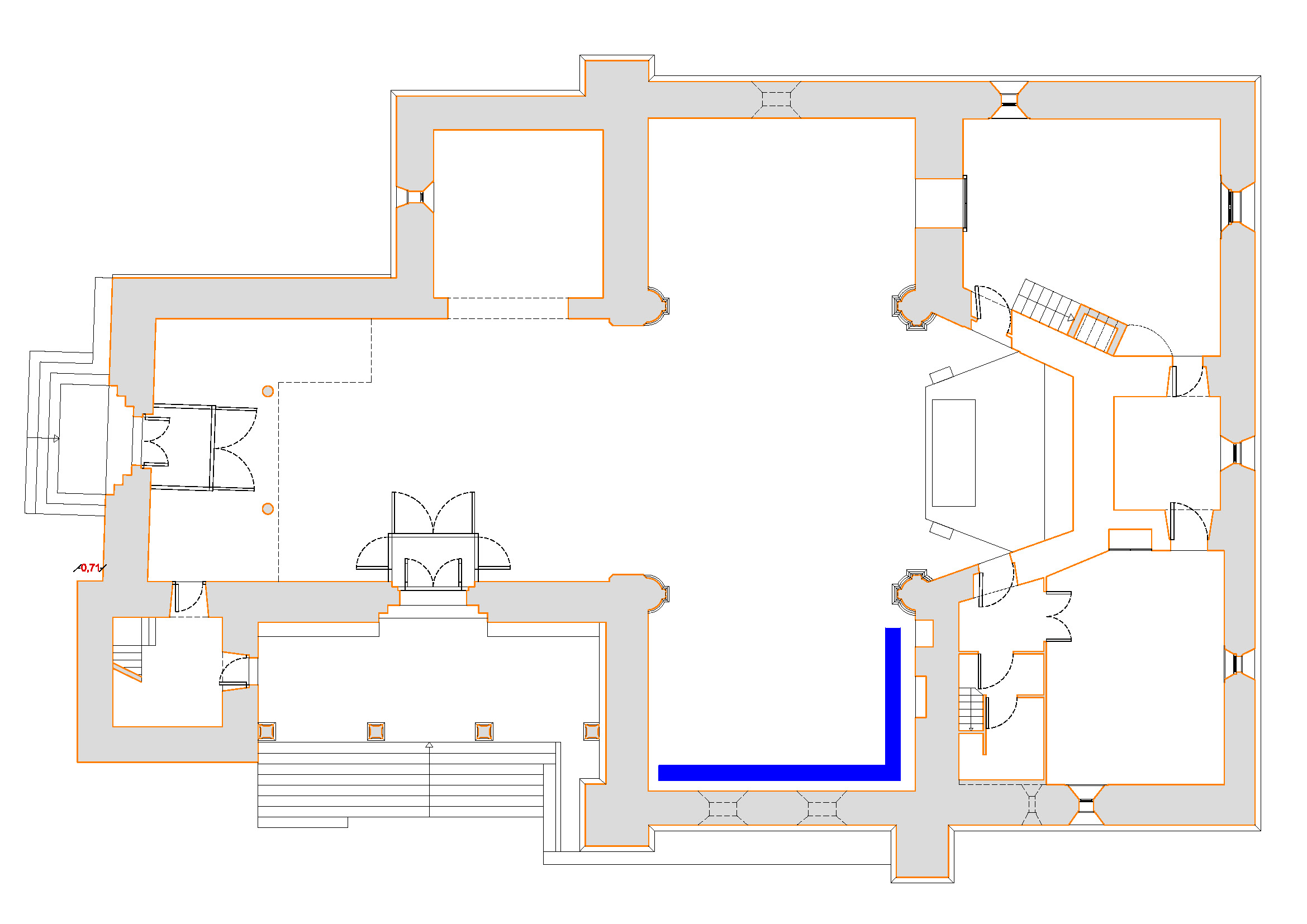
Interior visit
In 1748, repairs were needed on the wall supporting the altarpiece, which was subsequently dismantled.
«Support or repair the wall against which the altar of Our Lady of the Knives rests, build an external buttress to prevent the ruin that threatened the entire chapel, repair the vault of brickwork, and construct the entire sacristy located behind Jesus the Nazarene.»
Agustín Belicia Balboa, párroco (1748)
1.2 Altarpiece of the Virgin of Sorrows
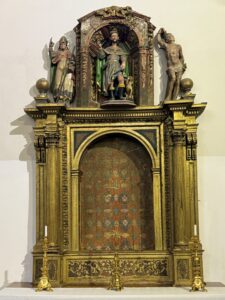
Retable of the Virgin of Sorrows
It is a single-body niche altarpiece with an attic, made of polychromed and gilded wood. The main body rests on a predella with panels where boards decorated with vegetal ornamentation are inserted, created using the gilding technique and fine brushwork. The central niche houses the Virgin of Sorrows. It is a dressed wooden image with a silver crown, pierced by seven metal swords through the heart.[1]
[1] Flor González Santos, Study on the conservation status of the movable goods of the Church of Santa María del Azogue in Puebla de Sanabria (Zamora), p. 1
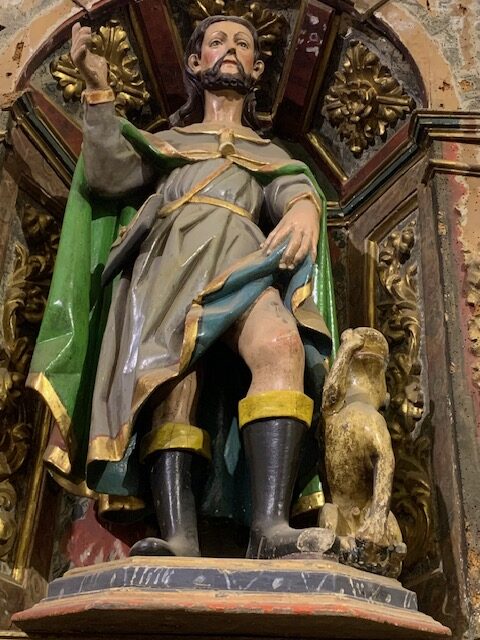
“The niche is flanked by two fluted columns with composite capitals, resting on prominent corbels. At the ends, the supporting elements are pilasters with volute capitals. The cornice features a moulding of smooth lines that projects significantly from the vertical plane, with a checkerboard decoration at its base. Above this rests the attic niche with a semicircular arch, topped with vegetal decoration and lateral finials, characteristic of the Baroque style. Inside is placed the polychrome wooden sculpture in the round of Saint Roch”[1].
[1] Ibid. Note 17, p. 4.
This image of the Dolorosa processes on Holy Thursday afternoon to the church of Saint Peter. It remains there until Good Friday morning, when it goes out to meet the Nazarene at the fourth station of the Way of the Cross.
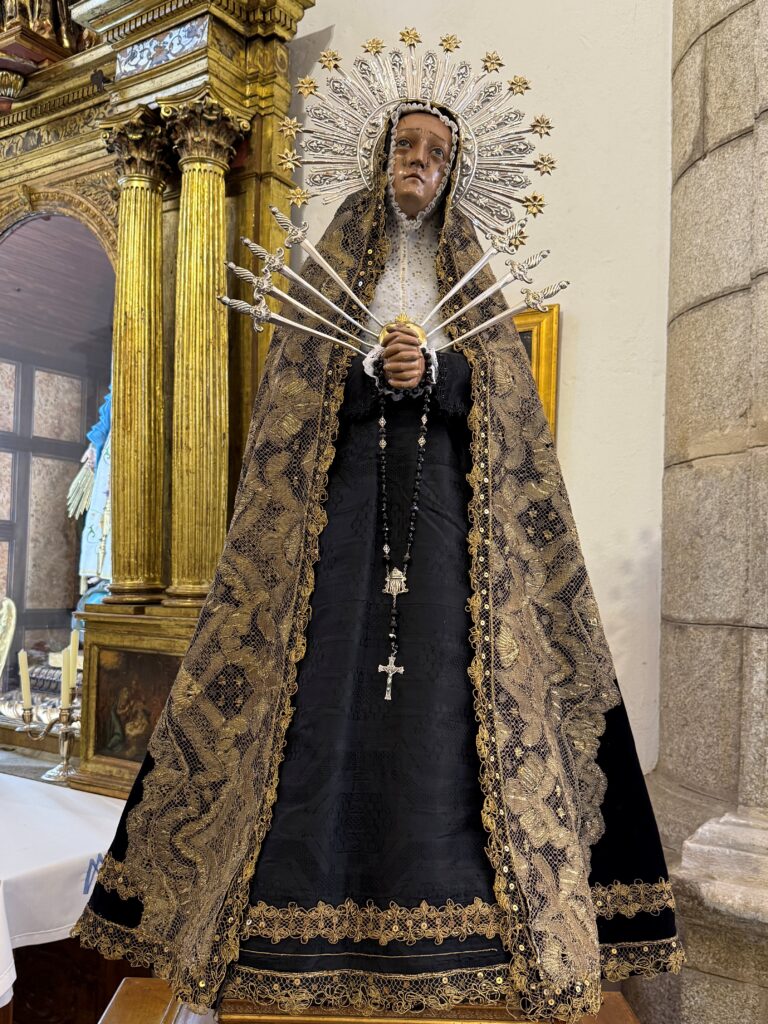
The foundation of this sculptural representation is found in the Gospel according to Saint Luke.
When the eight days to circumcise the child were completed, they named him Jesus, as the angel had called him before his conception. … There was a man in Jerusalem called Simeon, a righteous and devout man; when Jesus’ parents brought him into the temple, Simeon took him in his arms and blessed God, saying: “This child is destined to cause the falling and rising of many in Israel, and to be a sign that will be opposed – and a sword will pierce your own soul too, so that the thoughts of many hearts may be revealed.”
(Lc 2, 22. 25b. 27b-28. 34b-35)
In the 17th century, the liturgical celebration of two feasts dedicated to the Seven Sorrows began, one on the Friday after Passion Sunday, known as Friday of Sorrows, and another on the third Sunday of September.
The first was extended to the entire Church in 1472 by Pope Benedict XIII; the second in 1814 by Pius VII, in memory of the captivity he endured during the time of Napoleon. This second feast was permanently set for 15 September.
The celebration on that day refers to the Seven Sorrows of the Virgin. The number reflects a biblical influence, as the number seven is often used in the Holy Scriptures to signify indeterminacy and, perhaps more frequently, universality. According to this, commemorating the Seven Sorrows of the Virgin is equivalent to honouring the immense suffering of the Mother of God throughout her earthly life.
In any case, Christian devotion usually refers the sorrows of the Virgin to the following seven events: 1st the prophecy of Simeon; 2nd the flight into Egypt; 3rd the loss of Jesus in Jerusalem at the age of 12; 4th the meeting of Mary with her Son on the Way of Sorrow; 5th the agony and death of Jesus on the cross; 6th the descent from the cross; and 7th the burial of the Lord’s body and the solitude of the Virgin.”[1]
[1] Faustino Martínez Goñi, Los siete dolores de la Virgen, https://catequesisenfamilia.es (artículo)
Saint Roch
This figure of Saint Roch located in the attic of the altarpiece comes from an old hermitage situated on the other side of the river and adjacent to the Convent of San Buenaventura (currently known as the Church of San Francisco), as can be seen in the maps of the town from 1766.
Saint Fabian
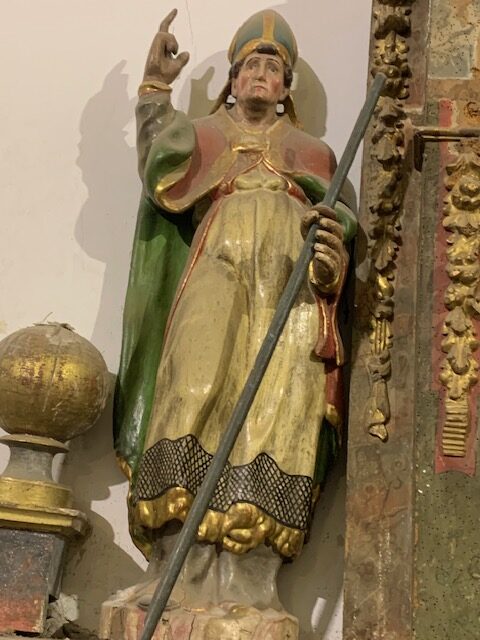
On the sides of the attic are Saint Fabian on the left and Saint Sebastian on the right. Both figures come from a now-lost hermitage whose location is unknown. This is reflected in the orders given by the Most Illustrious Mr Guillermo Martínez, Bishop of Astorga, during his visit to the town of Puebla de Sanabria on 4 October 1822: “As for the holy martyrs, Saint Fabian and Saint Sebastian, whose door is already bricked up, I order.”[1]
[1] Puebla Libro de Fábrica 1 principia 1732 – 1790 termina. De la iglesia parroquial, Folios 334 al 334 vto. (Archivo Diocesano de Astorga).
Saint Sebastián
Pope Saint Fabian died a martyr in the year 250 during the persecution under Decius and was buried in the Catacomb of Saint Callixtus. Saint Sebastian, son of a military father, became captain of the first cohort of the Praetorian Guard, respected by all and valued by the emperor who was unaware that Sebastian was a Christian at heart. He simultaneously held the position of soldier for the pagan emperor and soldier of Christ for as long as he could. This situation lasted until he was denounced, forcing him to choose between the two militias, and he chose Christ. The emperor condemned him to be shot with arrows. The archers took him to the Palatine Stadium; they tied him naked to a post and unleashed a shower of arrows upon him[1].
[1] Juan Fernando Roig, Año Cristiano -I- enero, Biblioteca de Autores Cristianos (Madrid 2002) Pág. 395-400.
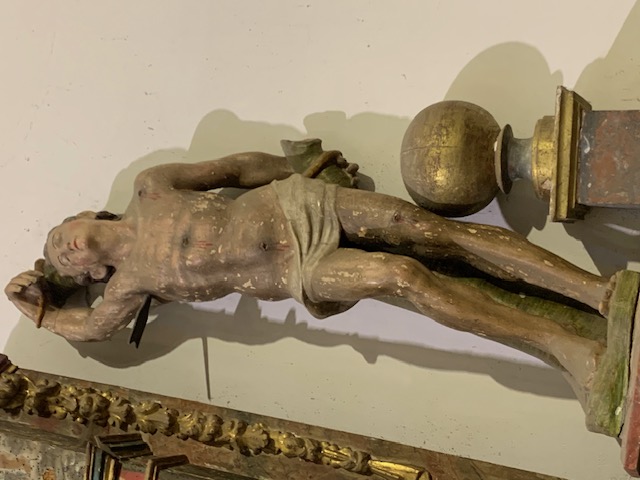
The veneration of Saint Fabian has always been closely linked to that of Saint Sebastian.
Both are celebrated on 20 January, on the feast day of the Holy Martyrs. «It can be stated that this attic, as well as the three images, are the result of an addition made after the execution of the altarpiece-niche. That is why the pedestal of the image of Saint Roch protrudes disproportionately from its position.»[1]
[1] Ibid. Nota 17 Pág. 4.
2.2 Altarpiece of the Nazarene
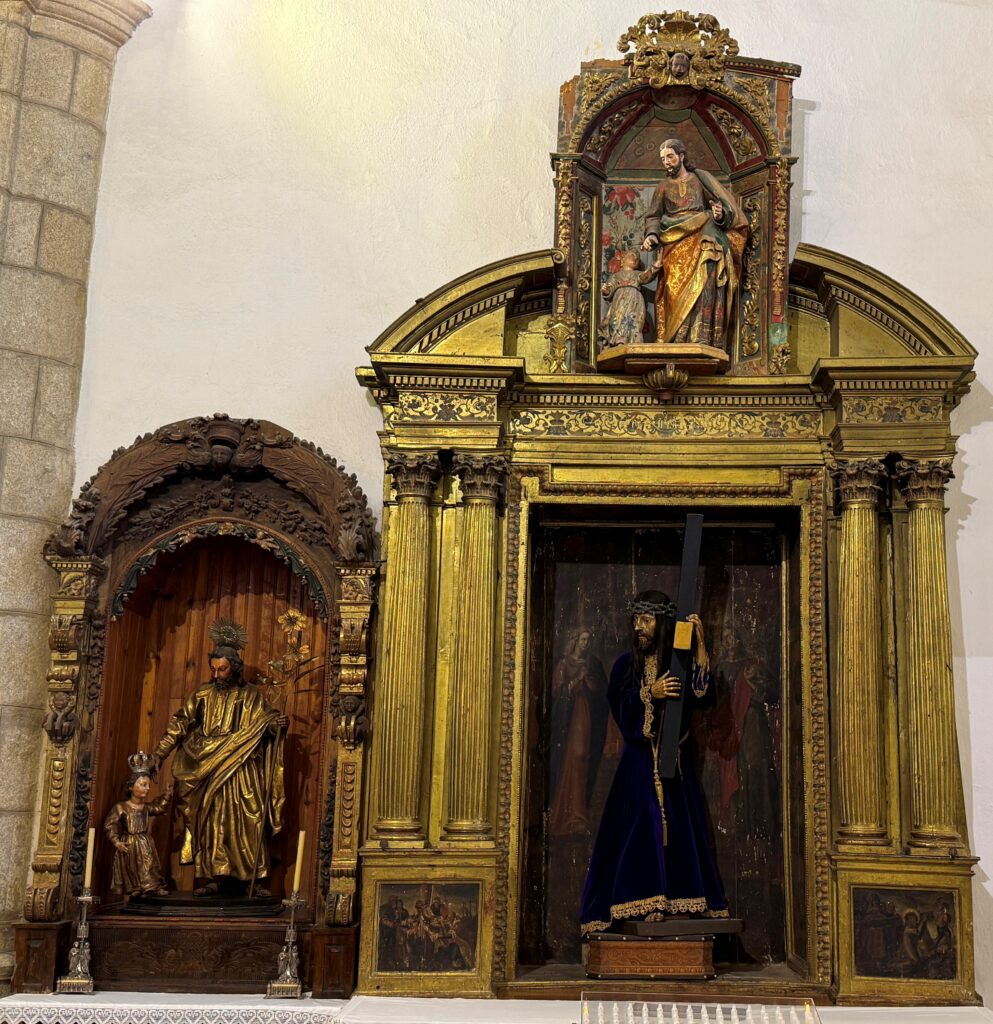
Turning in the transept in the indicated direction, we come across another “niche altarpiece” in the Mannerist style, consisting of a single section with an attic. The central niche is rectangular, with painted panels on the sides and background, depicting the figure of the Virgin and Saint John.
Image of Jesus of Nazareth
Inside the niche is the dressed figure of Jesus of Nazareth carrying the cross. The beard is carved while the hair is a wig, and he wears a crown of thorns.[1]
[1] Flor González Santos, Estudio sobre el estado de conservación de los bienes muebles de la iglesia de Santa María del Azogue en Puebla de Sanabria (Zamora), pag. 8
The biblical passage that inspires this collection can be found in the Gospel according to Saint John: “By the cross of Jesus stood his mother, his mother’s sister, Mary of Clopas, and Mary Magdalene. When Jesus saw his mother and the disciple whom he loved standing nearby, he said to his mother, ‘Woman, here is your son.’ Then he said to the disciple, ‘Here is your mother.’ From that hour, the disciple took her into his home.”
Jn 19, 25-27
Architecturally, it is flanked by two paired columns with fluted shafts that rest on two bases, featuring a polychrome panel at the front. On the left, the Descent of Christ from the Cross is depicted, and on the right, the Way of the Cross. The capitals are of composite origin and support an entablature with a frieze decorated with scrolls and foliage painted with brush technique, a cornice with a plain moulding and a checkerboard pattern. The semicircular broken pediment houses a Baroque niche adorned with abundant vegetal decoration, topped also with foliage, and in the centre, a cherubic head…
On the back of the Nazarene, there is an inscription in ink on paper that provides the historical details of the sculpture. It reads: «This figure belongs to the Third Order. Because the Third Order made it at their own expense in the year 1720.»
We can see that the cincture has three knots representing the three vows of obedience, poverty, and chastity. Popular oral tradition states that the image was made by prisoners using an elderberry root. It processes on Good Friday morning, accompanied by Saint John and from the fourth station onwards by Our Lady of Sorrows.
To discover the original composition of the altarpiece, we must focus our gaze on the crucifix located in the presbytery on the epistle side. This is the image which, placed at the centre of the polychrome panel of the niche, forms a Calvary scene. That is to say, Christ Crucified, His mother the Virgin Mary on the right-hand side, Saint John the beloved disciple on the left, and in the background Jerusalem and the walls of the Holy City.
This crucifix is known as the «Good Death» and is the guiding cross in all the Holy Week processions.
The interior of the niche is designed on three planes with a semi-spherical dome featuring lateral coffers decorated with carved gilded wood vegetation and a central panel painted on wood imitating marble. The central panel at the back is adorned with vases and floral motifs. The niche houses the sculpture of Saint Joseph with the Child, made of polychromed wood, in the round with finely polished flesh tones and garments decorated with gilding and fine brushwork. They rest on a plinth that projects from the vertical plane, supported by a vegetal corbel positioned in front of the entablature.[1]
[1] Ibid. Nota 24
It was Carmelite spirituality that made the devotion to the humble Patriarch triumph both within and beyond our borders. Saint Teresa was the shaper of this marvel. She took Saint Joseph as her advocate, praised his virtues, began foundations under his protection, and placed the first little portals under the shelter of his name. The only two inspired, canonical sources that reveal with absolute truth the person and life of the Holy Patriarch are the Gospels of Saint Matthew and Saint Luke. Matthew is the evangelist of Saint Joseph’s distress, of the Magi bearing gifts, and of the flight into Egypt amid threats. In Luke, we find the most essential scene, which can be regarded as the cornerstone of the Gospel of the Infancy: having heard from the very lips of Jesus’ Mother the moving account of the mysteries of God made child, we can savour the heavenly picture of the Christmas night.[1]
[1] Luis Morales Oliver, Año Cristiano -III – marzo, Biblioteca de Autores Cristianos (Madrid 2003) pag. 335-343
Adjacent to the altarpiece of the Nazarene, we find a small niche altarpiece believed to have been made by the carpenters and cabinetmakers of the town using remnants of other altarpieces and pieces carved by themselves.
This simple altarpiece is the offering of those who have Saint Joseph as their patron.
In tradition, a miracle is mentioned regarding the patriarch’s staff: the blossoming rod. This is part of the classic image of Saint Joseph and most likely originates from a text in Scripture.
The Lord spoke to Moses: Tell the children of Israel to give you a staff from each family: twelve staffs from all the heads of the patriarchal families. Write the name of each on its staff. On the staff of Levi write the name of Aaron, for there is to be only one staff for each family head. Place them in the Tent of Meeting, in front of the Testimony, where I usually appear to you. The one whose staff blossoms is the one I choose. This will put an end to the complaints from the children of Israel against you.’ The next day, when Moses entered the Tent of Meeting, he saw that Aaron’s staff, representing the house of Levi, had blossomed: buds had sprouted, it had blossomed, and produced almonds” (Numbers 17:16-20, 23).[1]
[1] Pedro Barrado, Why is Saint Joseph depicted with a blossomed staff? Vida Nueva Digital (Blog: Aaron’s Beard 12/5/2021) Article.
Continue with the interior tour.
The explanation focuses on four key points: front right section, central section, front left section, and central nave.